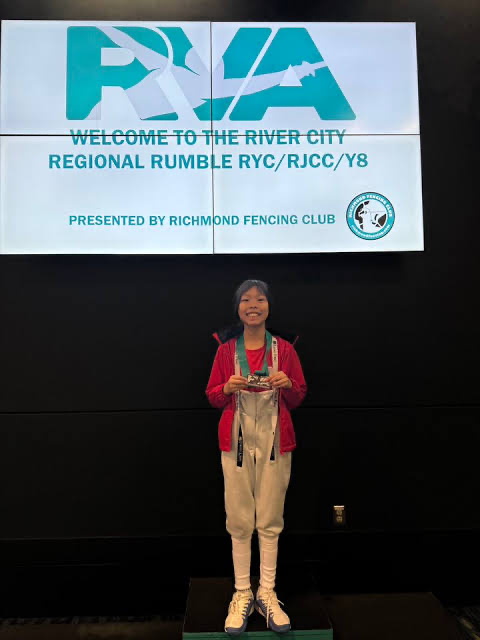
Sometimes an idea doesn't begin with a business plan. It begins with a child growing out of a fencing jacket.
Nina began fencing when she was about six years old. Like most young beginners, she entered a world that was completely new to her — masks, jackets, gloves, blades, body cords, footwork, distance, timing, tournaments, victories, defeats, and a vocabulary that only fencers seem to understand.
She also discovered something else about fencing: fencers help other fencers.
When Nina was just beginning, older members of her own fencing club had equipment they no longer needed. Some of it still had plenty of life left — a glove, a weapon, a fencing jacket. Instead of leaving those items in a closet or throwing them away, those older fencers passed them to Nina. To them, the equipment may have represented a chapter that had already ended. For Nina, it was the beginning of a new one.
From receiving to giving
The years passed. Nina practiced. She competed. She traveled to tournaments. She won bouts. She lost bouts. She learned. She grew stronger. And, quite literally, she grew.
That created a familiar problem for her family: her fencing equipment often didn't wear out before she stopped using it. Nina simply outgrew it.
Then something beautiful happened. The same cycle that had helped Nina when she was a beginner began moving in the other direction. Nina had equipment she no longer needed, and there were younger or newer fencers beginning the same journey she had started years earlier. So Nina began passing equipment forward too — a mask and other gear she had outgrown. Nina had gone from being the young fencer receiving help to becoming the fencer helping someone else begin.
A simple question
Watching this happen raised a question for Nina's family: What happens to all the fencing equipment children outgrow before it wears out? There must be thousands of masks, jackets, gloves, weapons, chest protectors, bags, shoes, and fencing parts sitting in closets and garages. And somewhere else, another family may be buying that exact piece of equipment for a child who is just entering the sport.
What if those two families could find each other — and what if the story could travel with the equipment?
That question became the idea behind Fence Forward.
Growing through fencing
Nina is an épée fencer at South Florida Fencing Club in Boca Raton, Florida. Her competition history shows a young athlete gradually moving from local youth events into larger regional and national competition — from winning Y8 and Y10 Mixed Épée events at Saved by the Bell in 2024, to competing at Capitol Clash and USA Fencing North American Cup events, and challenging herself in Y12 events. Most recently, she placed 7th in Y10 Women's Épée at the River City Regional Rumble in Richmond, VA.
But Fence Forward isn't interested only in medals. A fencing journey is much bigger than the podium: early mornings, long drives, hours of practice, nervous moments before a bout, a lesson learned from losing, a coach telling you to try again, a teammate cheering beside the strip — and coming back the next day to practice again.
The fencing circle
Nina's story is what Fence Forward hopes to make possible on a much larger scale: an older fencer has equipment they no longer need → a new fencer receives it and continues fencing → that fencer grows → they outgrow equipment that still has useful life → a new fencer receives it. This isn't simply recycling. It is a fencing circle.
Right now, most of these circles happen by chance — someone at the club happens to know someone. Fence Forward asks: What if we could make that circle much bigger? Across clubs. Across cities. Across states. Eventually, perhaps across countries.
Every fencer has a story
Nina doesn't have to become an Olympian for her fencing story to matter. Neither does any other child. A beginner's first competition matters. A first victory matters. Coming back after wanting to quit matters. Helping a teammate matters. Giving a younger fencer your old mask matters.
Every fencer has a story worth passing forward.